There will be a special meeting of the Board of the Special Education Parents Advisory Council on January 22, 2025 at 6:00pm via Google Meet for the purpose of discussing a November 2024 open meeting law complaint brought against the Special Education Parent Advisory Council’s board by a Cambridge caregiver and to discuss the nomination process and election for the Cambridge SE-PAC board.
Cancelled due to presenter illness The new date will be shared ASAP. Thank you for your understanding. For questions and comments please contact Zuleka Queen-Postell, ZQueen-Postell@CPSD.US
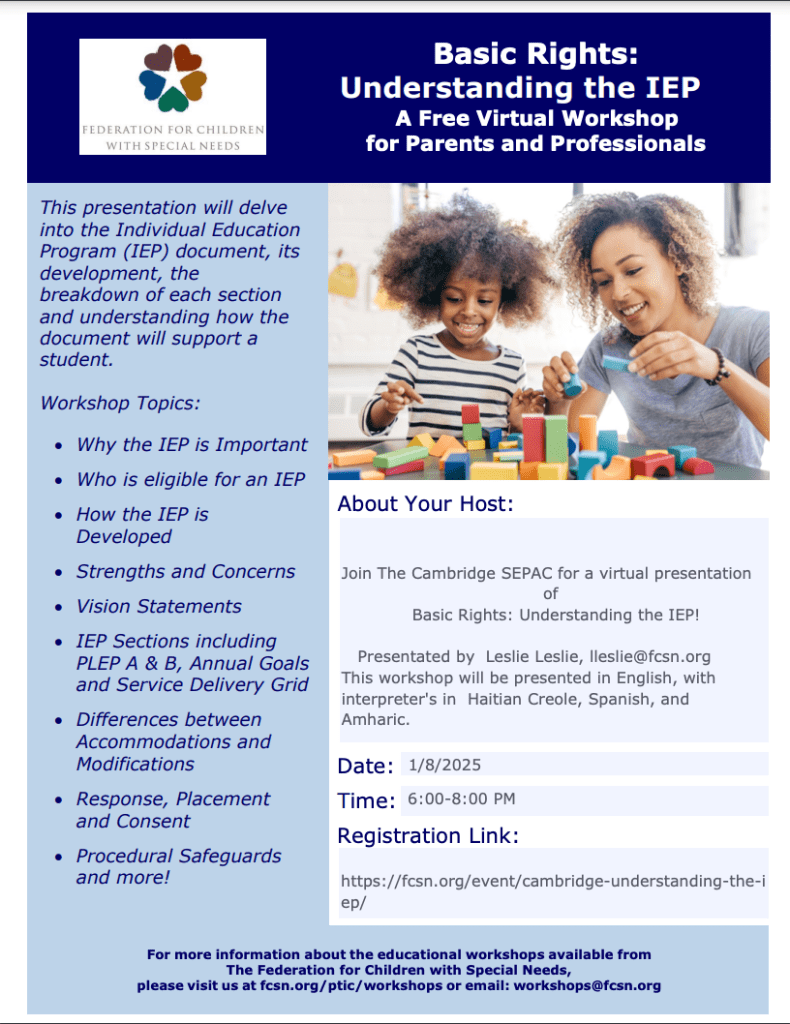
Workshop: Basic Rights: Understanding the IEP January 8th | 6PM-8PM
Presented in English, translated in Haitian Creole, Spanish, and Amharic.
This presentation will delve into the Individual Education Program (IEP) document, its development, the breakdown of each section and understanding how the document will support a student.
Workshop Topics: • Why the IEP is Important • Who is eligible for an IEP • How the IEP is Developed • Strengths and Concerns • Vision Statements • IEP Sections including PLEP A & B, Annual Goals and Service Delivery Grid • Differences between Accommodations and Modifications • Response, Placement and Consent • Procedural Safeguards and more! Presenter: Leslie Leslie, lleslie@fcsn.org Registration Link: https://fcsn.org/event/cambridge-understanding-the-iep/
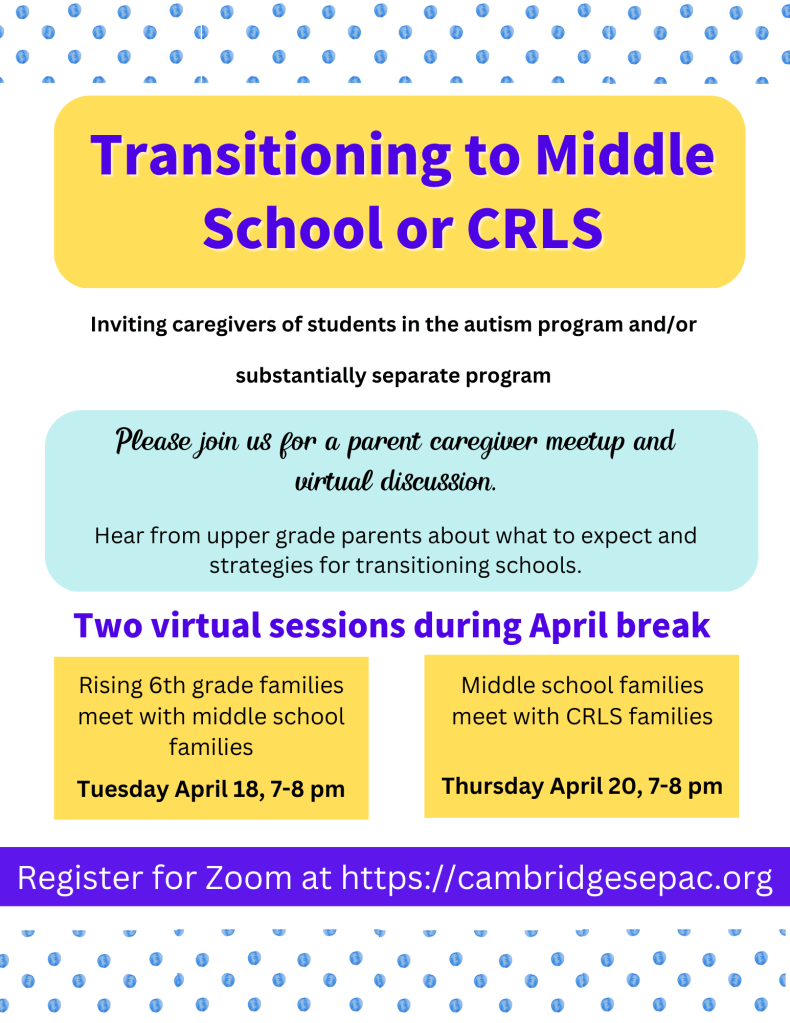
This program is for families of students in the ASD program and/or in the substantially separate classrooms to hear from upper grade parent/caregivers about what to expect and strategies for transitioning schools. We invite you to this virtual caregiver-to-caregiver meetup during April school break. There are two separate sessions both at 7-8pm on Zoom.
Who should attend: Families with students in the ASD program and/or in the substantially separate classrooms who are headed to middle school or high school.
Program: A panel of 5-6 upper grade caregivers will speak for 5 minutes each about what to expect in the upper grade — either at Cambridge Street Upper School or Cambridge Rindge and Latin School. Panel discussion is followed by 30 minutes of Q&A with your questions.
Parent/caregiver panelists will talk about:
The experiences of students in the ASD program at the upper grade school (CSUS for rising 6th graders, CRLS for rising 9th graders)
The experiences of students in the substantially separate classrooms at the upper grade school
What every rising grade caregiver/parent should know
Best practices at the upper grade school: how to help our children get the most out of the upper grade school
Any recommended classes and after school club/options
The Autism Parenting Summit from Autism Parenting Magazine takes place 1st-4th April 2022. This FREE virtual event features expert speaker sessions helping you navigate the challenges of the autism spectrum and learn how you can give your child the best start in life. See https://autismparentingsummit.com/
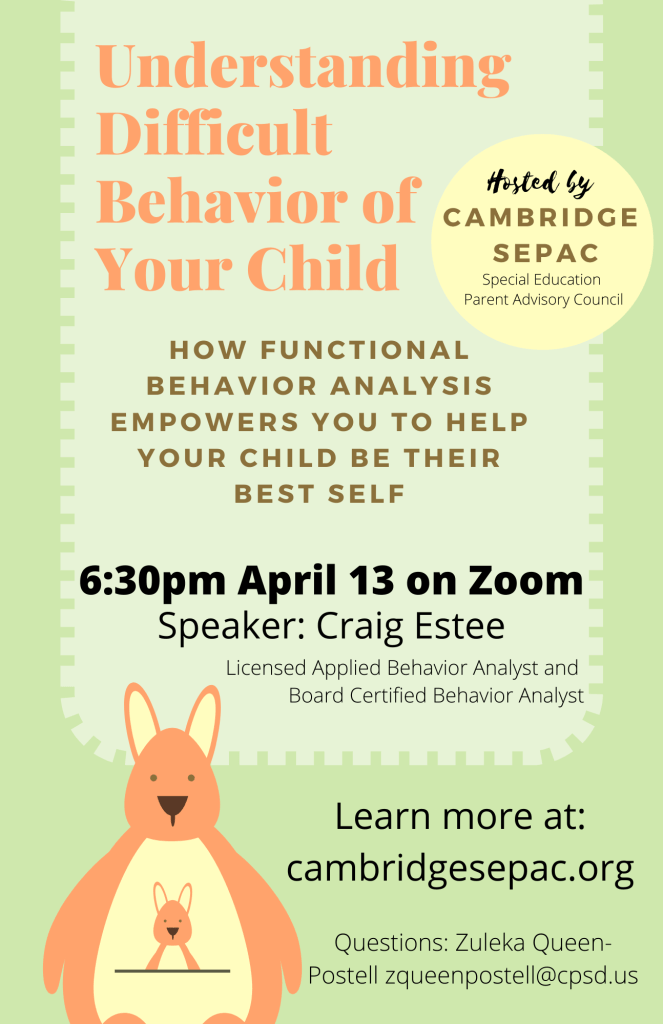
Special needs children are often labeled “oppositional defiant” or “troubled,” but starting from the basic assumption that all children want to “be good,” functional behavior analysis asks the question: “What need is not being met, which causes a child to act out?” Whether you are a parent/caregiver or an educator learn about
The four basic drivers that motivate difficult behavior
How to figure out what need a child’s behavior is communicating
Strategies to help a child get what they need in a socially appropriate way
When to ask for a functional behavior assessment at school and what it includes
From our speaker Craig Estee, M.Ed, BCBA, LABA, Special Educator, Behavior Analyst for ASD in Cambridge Public Schools, learn a science-based approach for getting to the root cause of difficult behaviors so that you can create the environment that will let your child be their best self.
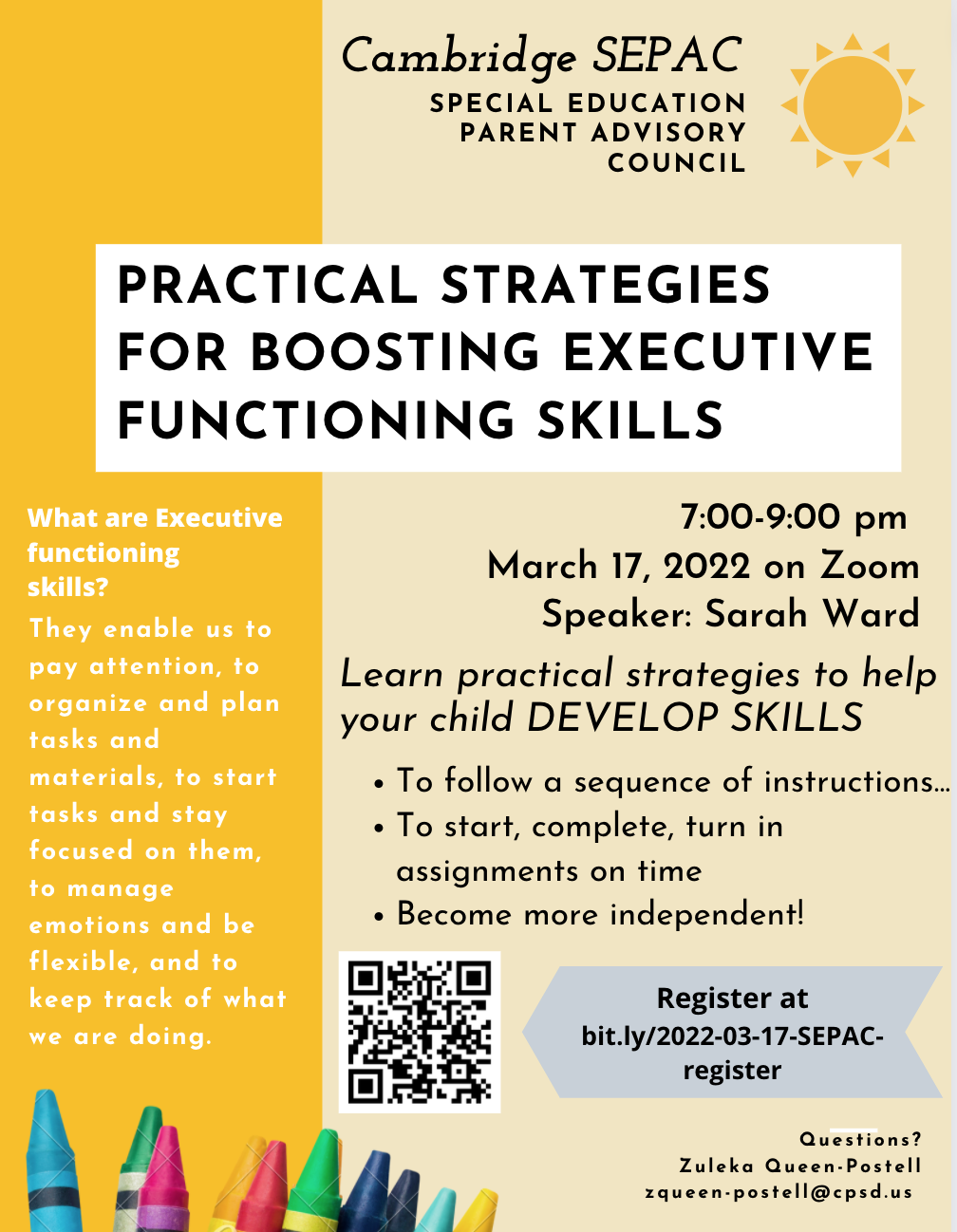
What are executive functioning skills? They are mental skills we use to pay attention, to organize and plan tasks and materials, to start tasks and stay focused on them, to manage emotions and be flexible, and to keep track of what we are doing.
Cambridge SEPAC is excited to welcome executive functioning skills guru Sarah Ward to speak 7-9pm on March 17, 2022 on Zoom.
Register to get the Zoom link at: https://bit.ly/2022-03-17-SEPAC-register
If your younger child has trouble following a sequence of instructions, or if your older child has trouble starting, completing and turning in assignments on time, they are struggling with executive functioning skills. In this practical strategies seminar by executive functioning skills guru Sarah Ward, caregivers will learn:
What the executive function skills are and how they affect academic and personal performance
How to help children develop executive function skills through everyday activities.
To help children learn to initiate tasks, follow routines, transition between tasks and think in an organized way and encourage self-initiative to manage homework and tasks
To help students understand time demands and internally feel the sweep of time to focus and complete tasks in allotted time frames.
To show students how to plan and complete homework, tasks and chores with less supervision and fewer prompts.
Sarah Ward, M.S., CCC/SLP has over 25 years of experience in diagnostic evaluations and treatment of executive dysfunction. Ms. Ward holds a faculty appointment at the Massachusetts General Hospital Institute of Health Professions. Sarah is an internationally recognized expert on executive function and presents seminars and workshops on the programs and strategies she has developed with her Co-Director Kristen Jacobsen. Their 360 Thinking Executive Function Program received the Innovative Promising Practices Award from the National Organization CHADD. She has presented to and consulted with over 1600 public and private schools in the United States, Canada and Europe.
Who: Parents/caregivers of children with special needs, or if you suspect that your child has special needs When: 6-8pm Thursday, November 18, 2021 How: Register to get the Zoom link at http://bit.ly/2021-11-18-sepac What: Federation for Children with Special Needs (FCSN) presents a free workshop about the Individualized Education Program (IEP) document, its development, the breakdown of each section and understanding how the document will support a student, and what the parents’ role is in shaping the IEP.
Topics covered:
Why the IEP is important and who is eligible for an IEP
How the IEP is developed for your child
The importance of the Parent Concern Statement
Description of the various IEP sections: their purpose and significance
Differences between accommodations and modifications
SEPAC held two forums with City Council candidates. Sumbul Siddiqui who was unable to attend is sending us her responses to the forum questions which we will post below when we receive them.
Session 1 candidates were: Theodora Skeadas, Alanna Mallon, Joe McGuirk, Robert Ekstut, Quinton Zondervan, Patty Nolan, and Nicola Williams (55 min 50 seconds)
Session 2 candidates were: Jivan Sobrinho-Wheeler, Burhan Azeem, Marc McGovern, Frantz Pierre, Tonia Hicks (camera unavailable due to Internet bandwidth issues) 42 min.
Candidates were asked to respond to the three questions below.
Federal and state civil rights, disability and education laws require that students with disabilities are provided equitable access to out-of-school time and community activities. This includes having adequate, appropriate support so that disabled children can participate in a meaningful way. Insufficient Monday-to-Friday programming impacts families; caregivers may not be able to work and students don’t receive the multiple benefits that involvement in social and recreational activities provides. The city has been chronically underfunding out-of-school-time programs that support students with disabilities. Some of the challenges families face are as follows:
Participation of children on IEPs delayed as the city’s Inclusion Initiative is extremely understaffed to evaluate the support needed (one person for the whole city)
Difficulty hiring enough inclusion facilitators to meet the demand (e.g., pay is too low). Some students are never included and “age-out” at 14.
Some families cannot participate because transportation home is unavailable for non-CPSD programs.
Currently the City of Cambridge only offers Saturday programming for the children with the greatest needs. How do we ensure that those children are provided programming after the school day Monday – Friday as well.
How do you reimagine Monday-to-Friday out-of-school time programs that will serve all of our special needs students?
The vocational options at CRLS need to be upgraded, updated, expanded, and modified to serve the needs of students with disabilities. How will you collaborate with the school committee, and use all relevant city resources and departments (e.g., for internships) to strengthen vocational programming?
The City has built a “Universal Design Playground” in Danehy Park. But presently, even though there is a city-wide “Healthy Parks and Playgrounds Initiative” some children with disabilities cannot safely use playgrounds throughout Cambridge. How will you ensure that all city playgrounds, structures, and events are accessible to children with disabilities?
Each candidate was given 2 minutes to respond to these four questions below:
Civil rights law and the Individuals with Disabilities Education Act require that students with disabilities be full participants in the life of the school and have equitable access to out of school time and community activities. We hear from many parents that this is not currently happening in Cambridge. How will you address this?
The Vision Statement for the district says that “The Cambridge Public Schools, in partnership with our families and community, will provide all students with rigorous, joyful, and culturally responsive learning as well as the social, emotional, and academic supports each student needs to achieve their goals and post-secondary success as engaged community members.” However, by 5th grade, 85% of students with disabilities are reading below grade level; and have the greatest achievement gap among all groups. What will you change and/or add to eliminate this disparity as well as close the achievement gap for all groups.
The school district has an obligation to ensure that all students with disabilities leave school with the ability to reach their full potential including their adult goals and dreams, not only in education, but in work, life, and community involvement. The district has currently not been meeting this requirement for all students. How would you address this, including making improvements in our vocational programming?
Students with disabilities have a right to be in the least restrictive environment and the majority of students with disabilities are in general education classrooms. Teachers seldom receive specific formal education which would prepare them to teach students with disabilities. What would you do to ensure that teachers are equipped to adjust or differentiate their instruction in order to meet each of their students’ needs.
On December 3rd, many caregivers attended our workshop: An Introduction of Executive Function for Elementary Families. As a follow-up, we have provided the slide deck, video, and the Q&A from the workshop. Materials
Google slide deck from the workshop (also attached as a PDF)
Video Presentation (Presented by Heather Francis, Lead Teacher for Special Start)
Questions and Answers from the 1-hour workshop (see attachment)
We will post all of these resources on the OSS Website, CPSD Family & Engagement website, and SE-PAC website. Homework: For the next few weeks, please incorporate some of these strategies Heather Francis presented on Thursday. Visit our Q&A document for more information.
Set up a regular routine (Visit this link for examples.)
Use a timer to help students stay focused while completing assignments.
Reflect with your child during meal times
Upcoming Events: Our next overview session will be held on Thursday, December 17, 2020, from 7:00 p.m. – 8:00 p.m. This will be an Introduction to Executive Function for Secondary Families (Grades 6-12). We will send a reminder email and zoom link two days prior to the meeting. Thank you, Desi Campbell

 Cambridge SEPAC is excited to welcome executive functioning skills guru Sarah Ward to speak 7-9pm on March 17, 2022 on Zoom.
Register to get the Zoom link at:
Cambridge SEPAC is excited to welcome executive functioning skills guru Sarah Ward to speak 7-9pm on March 17, 2022 on Zoom.
Register to get the Zoom link at: 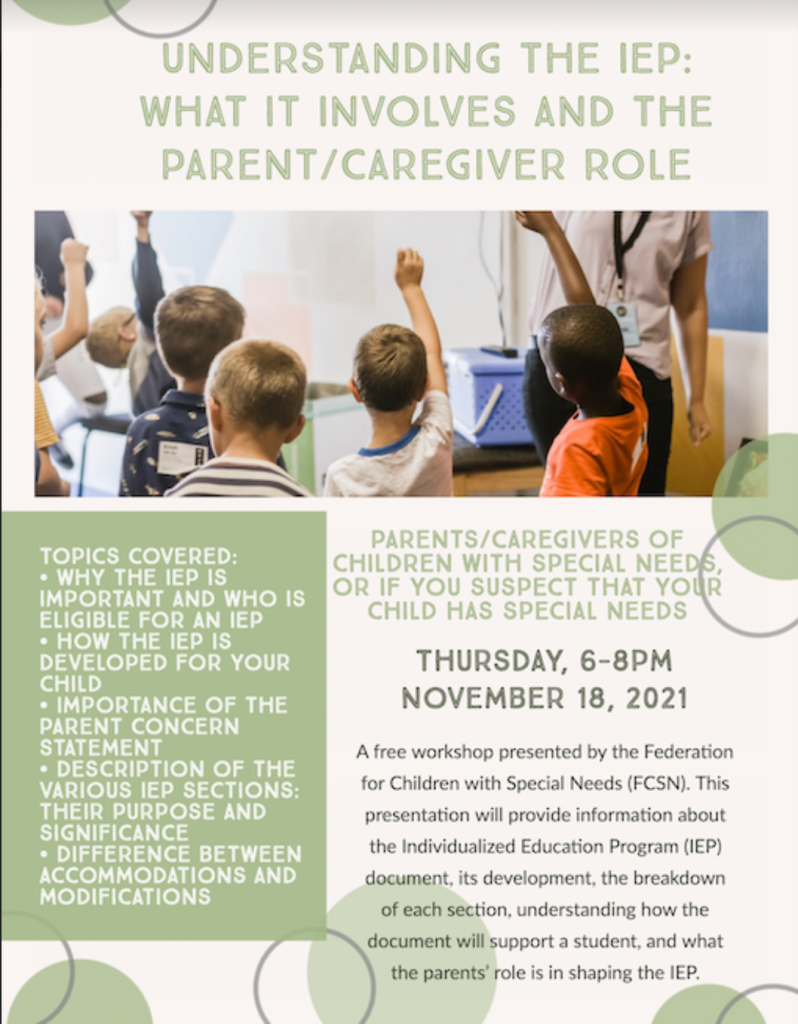
 Cambridge SE-PAC